
What Does ‘Normalization’ Mean in the Middle East?
Not the same thing to everyone, as it turns out.

Avi Gold, a self-described full-time world traveler since 2010, recently visited Lebanon. That by itself may not be noteworthy. But he is also an Israeli (with a Canadian passport), and while he was at the marina in Beirut, he filmed himself presenting his impressions in Hebrew. He called it beautiful, but noted that Lebanon was both very close to Israel and yet out of reach for the typical Israeli tourist.
The visit was, given anti-Israeli laws in Lebanon, illegal. Of greater interest is how many in the Arab social media space reacted with outrage. One response caught my eye in particular.
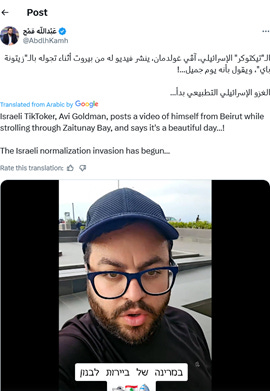
Normalization, as seen through the eyes of this fellow, is an “invasion” or “raid.”
Really, though, that’s nothing new.
In 1993, Shimon Peres published a book laying out his vision for how peaceful, normalized relations between Israel and the Arab world would play out to the benefit of all concerned. He described a Middle East of regional development, open borders, and shared prosperity in the wake of the Oslo Accords. Peres’s book, The New Middle East, was translated into Arabic two years later and released by Egypt’s state-owned Al-Ahram publishing house.
In the Arabic edition, an editorial foreword was added to help readers better understand what they were about to encounter. It said:
“When the Protocols of the Elders of Zion were discovered about two hundred years ago by a Frenchwoman and disseminated in many languages including Arabic, the international Zionist establishment tried its best to deny the plan. They even claimed that it was fabricated and sought to acquire all the copies in the market in order to prevent them from being read. And now, it is precisely Shimon Peres who brings the decisive proof of their authenticity. [...] This is not surprising, because the Protocols of the Elders of Zion, which were established by their wise men more than a century ago, are proceeding according to a meticulous and precise plan and time schedule, and they are proof that even though they are a minority, their goal is to rule the world and the entire human race.”
That was from Egypt. You know, the first Arab state to sign a peace agreement with Israel? No wonder it never really led to what you’d call “normalization.”
Other Arab-language media across the Middle East framed Peres’ kumbaya manifesto as a confession of “imperialist aspirations” to exploit Arab disunity. One description of the book referred to Peres as a “shrewd politician... crafting a regional order with a nationalist facade, massive economic plans, and a simplistic historical erasure of the entire fabric of Arab societies, all while calling for a ‘shift from a war economy to a peace economy.’” The reviewer said that the Israeli leader was concealing an intentional effort to undermine the Arab world by “repeatedly stating on every page that all of this is for the sake of a supposed peace.”
Unsurprisingly, in 1995 the Journal of Palestine Studies described the “peace economy” of Shimon Peres as an ideological tool to insinuate Israelis into Arab cultural spaces and dilute Arab-Islamic identity. In fact, the author of “Middle Easternism and Cultural Normalization with Israel: The Historical Dimension and Current Challenges” sees Peres’ book and Benjamin Netanyahu’s book, A Place Among the Nations, as two sides of “a comprehensive Israeli strategy seeking a peace conditioned on two forms of dominance: economic dominance and military dominance.”
And the conspiracy theorizing continues into the 21st century. The Qatari Arab Center for Research and Policy Studies (ACRPS) asserted in 2020 that peace and normalization with Israel masks the role of the Jewish state in regional instability. Peace with Israel, the center claims, is one of the reasons true political reforms are unable to go forward in the Arab world.
Right. It’s because of the Jews, don’t you know. At least that’s what they say in the authoritarian, hereditary monarchy of Qatar.
Yosri Fouda, a well-known Egyptian television host who also established Al Jazeera’s London office and starred in its lineup, revisited the foreword to The New Middle East in 2025. Considering the Abraham Accords, the war in Gaza and President Trump’s purported vision of a Gazan Riviera, he wrote:
“They succeeded in neutralizing the Arab regimes and tried with all their might to penetrate the mind and heart of the Arab citizen, but they failed miserably. This is the last bastion that will elude them until Judgment Day. They had hoped for a natural birth for their project of infiltration and domination, and the greatest proof of their failure is that they are now resorting to a cesarean birth by cutting open the mother’s abdomen.”
Also in 2025, Qatar’s Emir Tamim bin Hamad Al Thani warned that Netanyahu’s “true dream is to turn the Arab world into an Israeli sphere of influence” and urged against normalization. And Tariq Dana argued in an article for Al-Shabaka that Arab regimes that are deepening ties with Israel “transform a potential turning point for isolating the Israeli regime into an opening for intensified colonial expansion and regional dominance.”
Finally (for now), the independent Middle East Observer media outlet recently stated exactly what its editorial team thinks “normalization” means: “Israel will own the school, religious, and cultural curriculums of these countries just like they owned the Western curriculums after their victory in WW2.”
Ah yes, the Jews’ grand victory in the Holocaust and their subsequent hidden control of Western societies.
Of course, alongside the paranoid fantasies and conspiracy theories, there is actual movement toward a more stable and (hopefully) authentic normalization. The Abraham Accords between Israel, the United Arab Emirates, Bahrain, Morocco and Sudan were a historic step in that regard. As of now, it appears that the countries involved are committed to making it work on a deeper level than the cold peace Israel reached in past years with Egypt and Jordan.
As the UAE Foreign Minister Abdullah bin Zayed al-Nahyan said at the Abraham Accords signing ceremony in Washington in 2020, “Today, we are already witnessing a change in the heart of the Middle East, a change that will send hope around the world.”
Halavai.
Inshallah.
Even the supposed "warm peace" with the UAE can only exist because they are a dictatorship. The majority in all Muslim Arab countries are religiously and culturally antisemitic.
If warm peace is what we seek, the coalition that should be sought after is that with other oppressed minorites in the Middle East.
Nice friends and neighbors, especially Muslim (and perhaps Eastern European, from experience) will turn on Jews in a blink of an eye...